Friday, September 19, 2008

GREAT RIVER ROAD CARAVAN

We left Sun City on Sat, Sep 13, to meet the Winnebago travel group in Bemidji, MN. There we will follow a group of 20 Winnebagos 2,000 miles along the Great River Road which follows the Mississippi River to New Orleans. The river itself covers 2,300 miles as it winds its way into the Gulf.

On Sunday, Sep 13 we left Knoxville, TN enroute to MN, just past Lexington, KY we got cought up in the winds from hurricane Ike. All the way in Kentucky! Winds gusted to 70 mph and we had to pull off I64 and point north so that we would not be hit broadside. I could not hold the motorhome on I64 traveling west. So we sat on the side of the road for 4 hours untill the wind died down.


We stayed for two days in Madison, WS and visited the new Harley Davidson Museum in Milwaukee, which was 80 miles away.


There was a section in the museum where one could design their own HD, so, below is my gem! My dream Harley?? It's below!


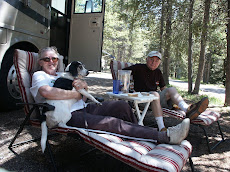
After 1637 miles, on Saturday, Sep 20, after 1637 miles, we arrived in Bemidji, MN at the Royal Oaks Campground to rondevouz with the others in our caravan. They include people from CA, WI, FL, MO, MD, IL, PA and SC. While touring the area, Millie enjoyed surveying the campground from the co-pilot's chair.


While at Bemidji, we toured Lake Itasca. the birthplace of the Mississippi River. From this humble beginning, the river flows 2,300 miles to the Gulf.


From Bemidji, we drove 103 miles to Brainerd, MN. There we toured the Charles Lindberg historic site in Little Falls, MN, his childhood home.


From Brainerd, we traveled southward 146 miles to the Twin Cities, Minneapolis - St. Paul. Two of the highlights here were Minnehaha Falls Park and seeing the Union Pacific Challenger which was visiting the city.


We also had a city tour, including the Minnesota Museum of Science, visited the Renaissance Festival, and bought nice fresh apples at a local farm.


From the Twin Cities we next traveled 210 miles south to Prairie du Chien, WI. So far, we've traveled a total of 2100 miles. Here, we visited Pikes Peak and the Effigy Mounds National Monument. This Pikes Peak overlooks the Mississippi River where it intersects with the Wisconsin River, across from Prairie du Chien


The Effigy Mounds are near Pikes Peak and are a collection of animal shape mounds about 2 feet in height, about 2,500 years old.


On Monday, Sep 29, we arrived in Galena, Il, where we toured the town and visited General U.S. Grant's home. In 1860 he moved from St. Louis to Galena with his wife and four children. We retraced his daily walk from the leather store on Main St. where he worked with his father and brother to his rented house on High Street. This walk included 175 steps and consisted of about 180 vertical feet. This was quite a hike for us. Below, I'm standing in front of the house he rented for $100/year, just prior to his volunteering in the Union Army at the outbreak of the Civil War.


By Friday, Oct 3, we were in Hannibal, MO, having traveled a total of 2538 miles. Here we visited Mark Twain historic sites. On the way, we stopped at Nauvoo, Il where we explored the restored homes and businesses of the Mormons, from where they departed to build a settlement in Utah. One of these businesses is that of the cooper or barrel maker. Here I'm sitting on the schnitzelbank shaping the wooden staves that form a barrel. This is quite nostalgic for me since my grandfather in Germany was a cooper.


Hannibal and the Mark Twain provided a perfect backdrop for our group picture. Before you are the owners and guests of the 20 Winnebago product motor homes in our caravan. I'm in the yellow jacket, lower center; Lill is right next to me in the red jacket. Boy, do we stand out?


In Hannibal, we toured the Mark Twain home and saw the houses that inspired Clemens to write about his youth here.


While in Hannibal, we visited a train museum which contained a real nice model train display.


On Oct 5, we arrived in St. Louis, 2656 miles from Sun City. On the way, we saw lock 24 in Clarksville, MO, about halfway between Hannibal and St. Louis.


In St. Louis, we had a city tour that included the Anheuser-Busch brewery and the Gateway Arch. From our RV site we could see the arch and the city.


En route to Memphis, we stayed in Cape Girardeau, MO. It's a small historic town on the Mississippi River that has an interesting painted flood wall.


From Cape Girardeau, we traveled to Graceland RV Park in Memphis, TN, right across the street from Elvis' home. We are now 2971 miles into our trip.


In Memphis, we also toured Mud Island, Beale St (music, beer & ribs), and the Pink Palace museum and IMAX theater. I ate a full slab of Memphis ribs for three days running. Man! They were good. The closest we have on Hilton Head is the Smokehouse.


From Memphis we traveled 242 miles to Edwards, MS where we toured Vicksburg and the National Military Park on Oct 13th. Below is a picture of the historic Vicksburg Court House.


After a total of 3,328 miles we arrived in Vidalia, LA, just across the river from Natchez. 80 miles of this was along the Natchez Trace from Jackson, MS to Natchez.


From our campsite we had an excellent view of Natchez, the Mississippi, and the bridge from Natchez to Vidalia. Vidalia has a beautiful paved walkway on top of the levee that extended from our campground 1.5 miles up river to the front of the landing at Natchez. The town of Vidalia is set a mile inland from the river due to flooding.


We toured Natchez including the Auburn historic home, ca. 1812, a postcard of which we sent to Michelle who is at Auburn in Alabama. We also toured Frogmore Plantation and got to pick cotton and see an historic steam operated cotton gin dating from the early 1800s. On our free day we visited the Emerald Indian Mound on the Natchez Trace.


We arrived at Poche's Fish-N-Camp on Oct 17th in Breaux Bridge, LA, having traveled 3,491 miles. From here, we visited St. Martinville home of the Evangeline Oak and the Tabasco Factory.


Our final caravan stop was Lakeside RV Park, Livingston, LA, 3,572 miles from Sun City. Here, we toured New Orleans, World War 2 Museum, French Quarter, and rode in a seaplane over New Orleans and environs.


Above is my cousin Bill Schmitz's Navel Base.


On Wednesday, Oct 22, our free day, we visited Oak Alley where we met the Parfits who were in our Caravan. At Oak Alley they were producing a TV movie "Midnight Bayou". After Oak Alley, we visited Laura Plantation. That night we had our farewell dinner.


Actors in "Midnight Bayou".


On Thursday, Oct 23, we had our farewell breakfast, the Great River Road Caravan was over. We left the caravan for Auburn, AL to visit Michelle. She gave us a tour of the campus on Saturday, Oct 25. Sunday, we left for home and arrived in the Sun CIty RV lot about 4:30 PM. On our way, we stopped at Sunshine RV Park, Castleberry, Al. The next morning we woke up to find the Quelets (Margie & Tom) camped right next to us. They had visited Douglas and Pat Lauck in Mississippi on their way up north to MD, who recommended the campground to them.


Tuesday, June 24, 2008

Wagner College 50th Reunion & Michelle's HS Graduation


June was a busy month for us as we traveled to Staten Island, NY for Walt's 50 reunion at Wagner College, June 6-8, 2008.

That weekend we enjoyed the Alumni Luncheon, a reception in the President's office, a dinner dance with a roaring 20s theme, a Broadway play A Chorus Line, and a brunch cruise in NY harbor by Ellis Island, Statue of Liberty and Governor's Island.

After that, we visited Steam town in Scranton, PA, a very interesting railroad museum operated by the NPS.We got a real neat tour of the RR Shop where there were many pieces of equipment from wheel trucks to boilers to engines being worked on. We were lucky to have spent the night at the old RR station in Scranton, the Radisson Inn.

We then went to the Finger lakes region on NY to visit an old college fraternity brother in Skaneateles, NY and Hammondsport, NY, where we toured the Bully Hill Vineyards and visited the Curtiss Museum.

From there, we drove to Newtown, CT to visit our daughter & and family; it was Michelle's HS graduation. While there, we visited with my former Wagner classmate Betsy and her husband Bob Press in Rhinebeck, NY, which was only about a 90 minute drive away through very scenic parts of CT and NY.

Our trip covered 2,600 miles.

We arrived safely home on the 23d.

Saturday, April 19, 2008

GETTYSBURG - NEW VISITORS CENTER

On Thursday, April 17th we visited Gettysburg, PA and the new Visitors Center. The center just opened up on Monday, April 14th. It presents in some detail the three days of battle on July 1, 2, & 3, 1863 in both film and displays. There is also a large gift shop and restaurant. From here, one can book tours to the battlefield as well as the Eisenhower farm. The center also has two large theaters showing an informative film on the battle and the events that lead up to it. Admission to the museum is free, however there is an $8 charge to see the film. After purchasing our tickets, we settled in to watch the film. Just as it was about to start, there was a very loud noise. It was the fire alarm! The whole center had to be evacuated. Since we had already handed in our tickets, we wound up outside, no tickets. Due to the evacuation, we were unable to get a refund, but the staff said all we had to do was come back and show them our tickets. But we had none. Fortunately, we were able to re-enter after about 15 minutes and were able to see the film; this time without any disruption.

Prior to visiting the Visitors Center, we booked a commercial battlefield tour for $41.50/pp which included three local museums. We visited the Lincoln Train Museum. This was really interesting, it contained numerous model train sets from the 1800s to today by Lionel, Marks, Ives and MTH. One of the most interesting was a chrome set made by Ives that sold in 1925 for $100; it has to be worth a small fortune today. They also had an operational model railroad. Its main attraction was a simulated train trip through the Civil War countryside made by Lincoln on his way to Gettysburg to deliver his famous speech. The Gettysburg Battle Theater was also interesting; it gave an excellent overview of the military events that lead up to Gettysburg and the three days of battle. This turned out to be a good stop prior to our battlefield tour. The third museum we visited, the Soldiers National Museum, turned out to be a real rip-off; poorly designed with trivial displays of little educational or other value.
For dinner, we ate at the Dobbin House Tavern. It had a Civil War era atmosphere, the building being one of the oldest in Gettysburg. Food, drink and ambiance were excellent. We would highly recommend this for a very enjoyable dinning experience.

The battlefield tour conducted by a licensed tour guide proved to be real interesting and worthwhile. The two hour tour gave us a real good appreciation of the three days of battle, the significance of the terrain and the major events that took place.
We stopped at Little Round Top and learned about Gouverneur Warren and his last-minute defense of Little Round Top. This is a hill at the left flank of the Union defenses that on the second day of battle, as the Confederates were attacking, was as a result of some Union maneuvers left undefended. Brigadier General Warren was General Hooker's chief topographical engineer and not in command of troops. However, he recognized the importance of the undefended position on the left flank of the Union Army and on his own initiative, organized its defense just in time to stop a Confederate assault. For this he is known as the "Hero of Little Round Top"; his gallantry and initiative was instrumental in the Union victory at Gettysburg and in turn for preserving the Union.
As with all the others who fought to preserve the Union, we owe them so very much. Each one of us should make time to visit Gettysburg and other Civil War sites to recognize and honor the sacrifices that made our country great, united and free, whose wealth and blessings we now enjoy in freedom today, so that we may all continue to do so in the future.

Monday, February 25, 2008

A Passion for Civil War History

Whether you’ve come to the Lowcountry from Up North or are a bona fide Southerner, sooner or later, you are going to find that the Civil War is part of our local heritage. Yes, it really did happen here.
The War of Northern Aggression, the War Between the States, the War to Preserve the Union, or the Recent Unpleasantness are terms used, depending upon your perspective, to refer to this war. Being a newcomer to South Carolina, I decided that I wanted to know more about what happened here almost 145 years ago. The more I learned, the more interesting this part of our history became. Did Sherman really burn down all those buildings in Beaufort and Bluffton? Did the Confederacy ever have a chance to win? What kind of men were Lee and Grant? What was it like for Lincoln and Davis to govern during these tumultuous years?
Like many others interested in studying the Civil War, I joined the Lowcountry Civil War Round Table, impressed with their organizational philosophy: the War was the defining moment in the history of our country. It established that we would henceforth be one nation, indivisible. With nearly 400 members from the local area, the Round Table provides a form for hosting renowned Civil War historians and professional impersonators (e.g., General Robert E. Lee) at meetings held locally in Bluffton.
Through the Round Table, I became aware of The Blue and Gray Education Society (BGES) , a national organization dedicated to our further understanding of the War Between the States by interpreting and preserving Civil War battlefields, conducting high quality seminars, promoting and publishing scholarly research, and by facilitating worthy educational endeavors. Each spring, they hold their Atlantic Civil War Symposium on Hilton Head Island. To understand a battle, you have to walk the battlefield; you need to see the actual terrain where the battles took place to get an understanding of the difficulties faced by both the troops and the generals who led them. This upon the heels of a classroom lecture or reading one of the many good books available is really what makes history come alive.


Walt at a BGES battlefield seminar, Shiloh, MS.


The University of South Carolina at Beaufort offers many excellent courses throughout the year on the Civil War. One of the benefits that as a senior I have taken advantage of is the ability to audit a course at a reduced rate. A great fringe benefit is enjoying the dialog with the young students, for some of whom, Civil War history is their recent unpleasantness. One of my courses was about the battle at Chattanooga, Tennessee which was held under siege by Confederate positions on Lookout Mountain. As seen in the accompanying photo of the Confederate cannon, my visit there helped me greatly understand the remarkable heights from which they commanded the city and the Union forces trapped there. Even more remarkable was the fact that the Union Army led by U.S. Grant stormed this position from below and managed to dislodge the Confederates.

Confederate cannon on Lookout Mountain.

The subject of the Civil War through my participation in educational organizations and with the many battlefield and museums within a day’s ride or two is for me an interesting and exciting hobby making history come alive.
To understand the challenges President Lincoln faced in this 1864 reelection, the reelection of President George Bush offered to me some insight: both took place amid serious dissent on the home front in a time of war. Bush faced similar criticism that Lincoln endured in 1864. The Patriot Act, supported by Bush, is challenged for taking away some liberties; Lincoln faced similar criticisms for his suspension of the writ of habeas corpus, granting sweeping powers to law enforcement and imprisonment of Southern spies and sympathizers without trial. Bush and Lincoln were criticized for their lack of intellect, large number of casualties and a mismanaged war effort, and endured opposition from Europe. While both were in the military, Lincoln served for less than three months in what could be called the National Guard of that era; Bush’s National Guard service was hotly debated. Bush faced an opponent eerily similar to McClellan. Like Kerry, McClellan was a war hero in a predominantly anti-war party and was also highly criticized for his military record by Republican supporters. Both were generally adored by the troops under their command. McClellan grew up as a member of the Philadelphia aristocracy while Kerry was a member of the Boston elite. Both flip-flopped on major issues. Whoever succeeds Bush needs to be better than Lincoln's successor.
As I get more involved with Civil War history, I find that to really understand why it occurred, you need to study our history from the establishment of the first colonies of Spain, France and England, not only in the U.S. but also in South America and the West Indies. The period after the Civil War merits study to understand the aftermath of this bloody struggle and its influence on the development of our nation.
History is a never ending sequence of people and events; starting with the Civil War and going back and forth in time is an interesting, stimulating and rewarding way to understand as much as possible about what took place here 145 years ago.